Marie Antoinette Has No Time for This explores silence as both a personal and collective response to abuse within the theatre profession, seeking to understand how it emerges, how it is sustained, and what it leaves behind in those who experience it, observe it, or unwittingly contribute to its preservation. It is an attempt to answer the timeless question: How come no one knew anything?
At the centre of this story lies neither the act of violence nor the relationship between perpetrator and victim, but the conscious and unconscious witnesses, and the space that forms around them: a silence shaped by things left unsaid, born out of discomfort, adaptation, loyalty, fear, shame and helplessness. Boundaries become blurred, and responsibility is often diffused across the collective. Silence emerges as a complex mechanism of survival, protection, control and tacit consent, accompanied by a tragicomic attempt to evade what so many are unwilling to see.
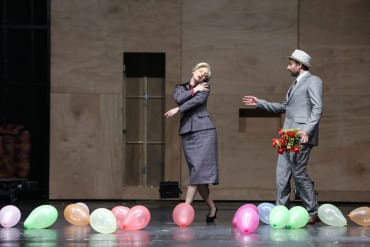
The play unfolds inside a theatre, and its central figure is a middle-aged actress, a close friend and long-time collaborator of the accused director. We encounter her at the moment the scandal breaks, just before the dress rehearsal of his new production, in which she plays the leading role, that of Marie Antoinette. From her perspective, we observe the theatre as a space in which work is supposedly grounded in trust and vulnerability, but also as a space where relationships can become invisible and what happens behind closed doors can pass without anyone speaking out.
At a time when, in the wake of concrete cases of abuse, public attitudes are finally beginning to shift, we are pursuing the initial question: How come no one knew anything? But Marie Antoinette does not wish to be asked such questions: she is burnt out and simply has no time for it.
The text was developed as part of the Drama Residency project during the 2024/2025 season, and will be brought to the stage by its author, Sanja Milardović.