Although rarely performed, and marginalised and disputed by opposing political regimes during his lifetime, Radovan Ivšić occupies a distinct place in Croatian drama and literature today. A surrealist poet and playwright, Ivšić penned the visionary drama King Gordogain, using allegory and lyrical language to portray the brutal tyranny of a despot ruling over an imagined kingdom. Drawing inspiration from the proto-avant-garde farce Ubu Roi by Alfred Jarry, and alluding to Elizabethan drama, the symbolist theatre tradition and surrealism, Ivšić crafted a stylised and poetic text that juxtaposes the enchantment of a fairy-tale world with its inherent brutality.
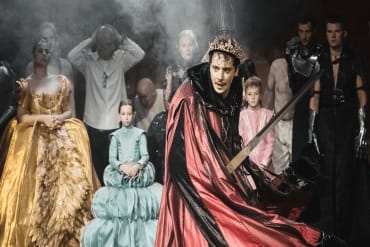
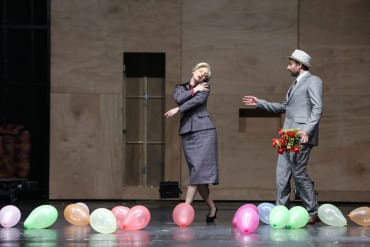
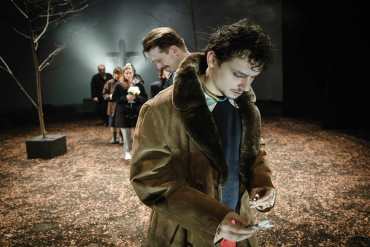
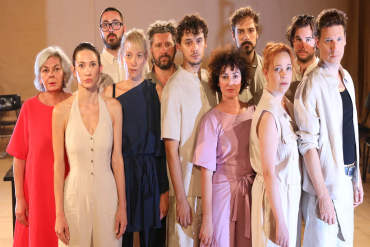
Gordogain usurps the throne by killing the White King and imprisoning White, the king’s daughter. His reign pushes the kingdom to the brink of collapse, and the people place their last hopes in the arrival of an honourable knight who may put an end to their torment. René Medvešek’s direction of this classic unveils its boundless theatrical potential. His approach focuses on sound, silence and the spoken word, accentuating the beauty of Ivšić’s poetic language through a refined exploration of stage speech and vocal action. Evoking Ivšić’s prolific artistic legacy, the production features a cast of young actors who recall the Youth Ensemble (Družina mladih), a progressive theatre troupe from the 1940s of which the playwright himself was a prominent member.
Presented for the first time at the Drama of the Croatian National Theatre in Zagreb, King Gordogain emerges as a theatrical event, a tribute and an echo of past times resonating in the present moment.