CNT About the Building

History of the Building
The first professional theatre in Zagreb was built in 1834. It was constructed by the Zagreb wholesaler and landowner Kristofor Stanković, who in 1833 won the main prize in the Vienna lottery in the amount of 30,000 ducats and decided to invest privately in building a theatre. The City Magistrate granted him a plot of land at the corner of Markov trg (St. Mark’s Square) and Freudenreichova Street, and in the summer of the same year construction began on the theatre building, which would remain in private ownership until 1851. The building was designed in the Neoclassical style by the Italian architects Christofor and Anton Cragnolini, father and son, who were working in Ljubljana. The grand opening of the building took place on 4 October 1834, in honour of the name day of Emperor Ferdinand I. In its first years, the stage hosted exclusively German theatre troupes, and on 10 June 1840, with the world premiere of the heroic play Juran and Sofija or The Turks at Sisak by Ivan Kukuljević Sakcinski, performed by the Native Theatre Society from Novi Sad, the Croatian National Theatre in Zagreb began its activity.
The so-called Stanković (old, Upper-Town) Theatre also included a ceremonial hall for dances, where in 1848 the Croatian Parliament held its sessions. The Upper-Town theatre was the centre of the city’s theatrical and cultural life, and for the population of that period its capacity (more than 750 seats) was sufficient, although the theatre was not technically well equipped.
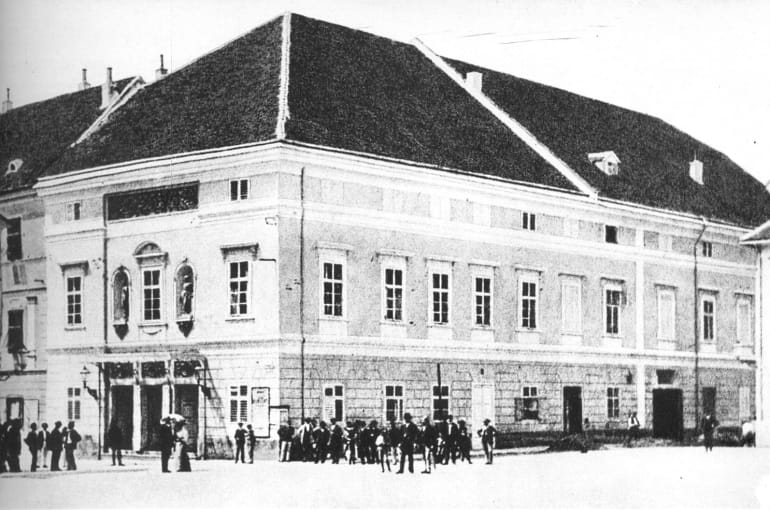
Stanković Theatre, photo by Ivan Standl, c. 1890
When the new theatre building opened in 1895, the Upper-Town theatre was converted into administrative space; today it houses the assembly hall of the City Assembly. The development of European cities in the second half of the 19th century and new urban planning in which theatres held a particularly prominent place were among the indicators of the strength of liberal bourgeois society: from the end of the 19th century until the beginning of the First World War, around 1,500 theatre buildings were constructed throughout Europe. In Croatia, new theatre buildings were erected in Zadar (1865), Dubrovnik (1865), Osijek (1866), Šibenik (1870), Varaždin (1873), Rijeka (1885) and Split (1893), so the capital could not lag behind. With the increasingly rapid development of the theatrical arts, both artistic and technical requirements in Zagreb far exceeded the possibilities of the Upper-Town stage, especially after the founding of the Opera in 1870 and the Ballet in 1876.

Ferdinand Fellner (1847–1916)

Hermann Helmer (1849–1919)
Plans for a more advanced theatre building had been considered intensively since 1871, but nothing was done until the earthquake of 1880, which significantly damaged the Upper-Town theatre and intensified the question of building a new one. A Theatre Committee chaired by the Croatian writer and Member of Parliament Marijan Derenčin was appointed in April 1880. It began raising funds, submitted a detailed petition to the Government regarding the need for a new theatre, and commissioned architectural plans from the Vienna-based theatre specialists Hermann Helmer and Ferdinand Fellner. In June 1881, the Croat