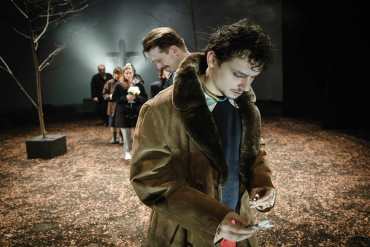
Since its premiere in 1929, The Glembays by Miroslav Krleža has become one of the most frequently performed Croatian plays. At the CNT in Zagreb alone, it has been staged almost every decade, as if each generation had felt the need to recognise its own Glembays anew.
The play forms part of Krleža’s Glembay cycle, comprising eleven prose works and three plays published between 1926 and 1930. The dramas within the cycle are widely regarded as the pinnacle of Krleža’s dramatic achievement.
Krleža conceived The Glembays as a literary portrait of a bourgeois civilisation in decline, caught in its final agony. Beneath the glittering surface of privilege lies a society of murderers, swindlers and moral ruin, one in which, as Krleža writes, ‘everything smoulders like phosphorus’ while champagne is drunk atop a volcano. At its centre stands Leone Glembay, one of the most important protagonists of Croatian dramatic literature. Torn between the private and the political, personal freedom and social responsibility, between his father and Baroness Castelli, between life and suicide, Leone becomes the central figure through whom Krleža explores guilt, inheritance and revolt. The middle and only surviving son of Ignjat Glembay and Irene Basilides-Danieli, Leone is regarded within the family as an uncomfortable misfit: a painter of some success, though never fully accepted on his own terms. After leaving Cambridge, he spends eleven years wandering from Paris through Switzerland to Calcutta, retreating into fashionable spa towns and living off the family fortune, before returning home for a final confrontation. Within the family setting, over the course of just twenty-four hours, Leone attempts to free himself from the Glembay spirit within and around him. He finds himself caught in a series of emotional entanglements and on the brink of scandal on the eve of his final reckoning with his father.
In The Glembays, Krleža portrays people, in his own words, with ‘all the murky, egoistic, aggressive, libidinous or even perverse inclinations of human nature.’ In the span of a single night, between life and death, we are once again invited to a final supper in the Glembays’ home.
The Glembays by Miroslav Krleža will be directed by the acclaimed director Paolo Magelli.