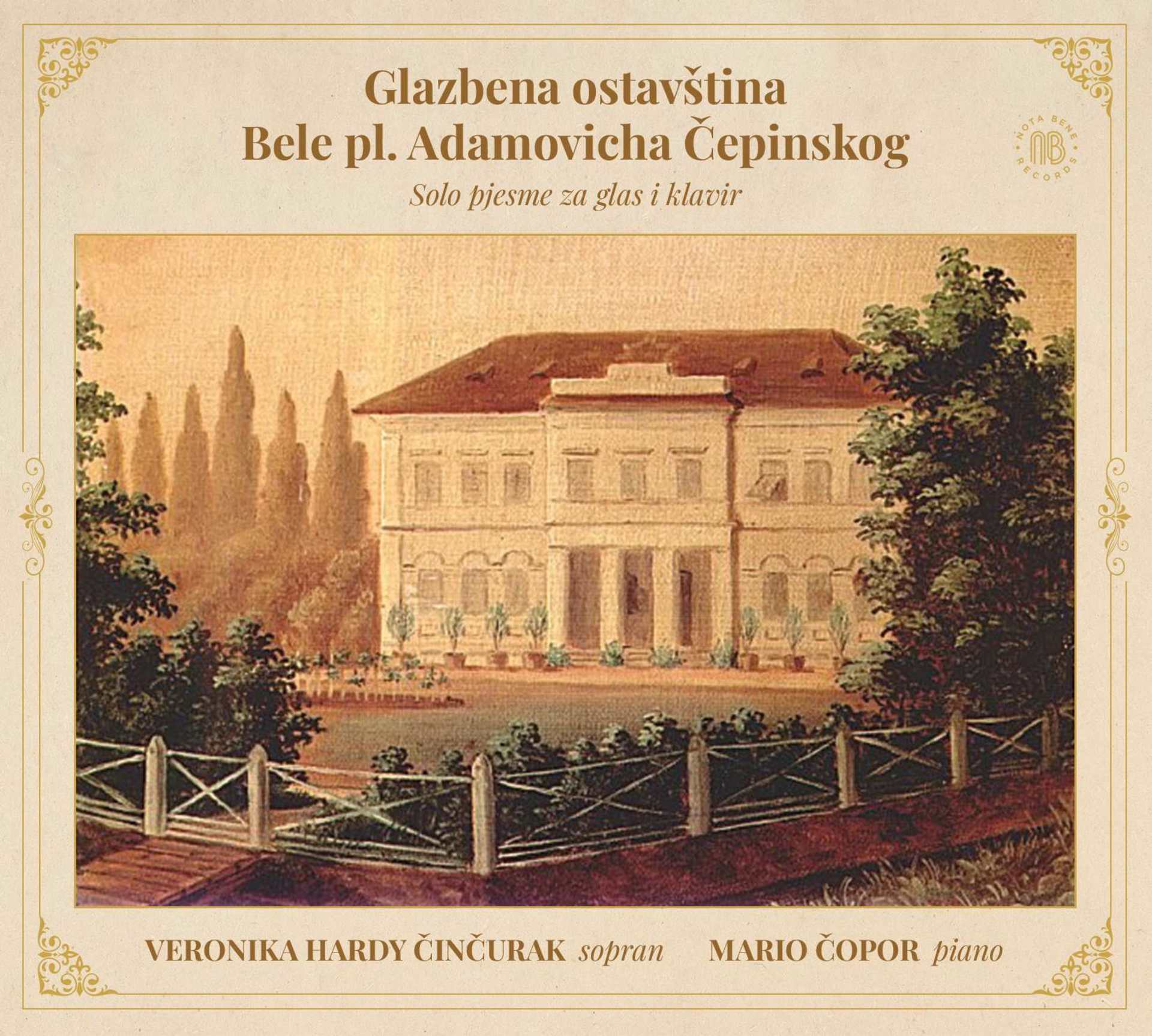
PROGRAMME
1. Cvjetala mi ruža
2. Siva ptico
3. Zimzelen
4. Govor glasova
5. Nekoć
6. Ciganska svadba
Veronika Hardy Činčurak, soprano
Mario Čopor, piano
Participants
Hrvoje Pavić, PhD
Matko Brekalo
Mladen Malek
Bela pl. Adamović Čepinski (1856–1934)
Bela pl. Adamović Čepinski was born on 15 September 1856 in Čepin, the son of Ladislav pl. Adamović and Oktavija, née pl. Mihalović. He was a member of the prominent Slavonian noble family Adamović Čepinski (de Csepin). The Adamović family came to Slavonia following the suppression of the uprising of Bulgarian Catholics in Chiprovtsi in 1688. At the beginning of the 18th century, the family lived in Pécs, while from the mid-18th century onwards it became closely associated with Čepin, Osijek and Slavonia—a connection that continues to this day.
After completing his secondary education at the grammar school in Osijek, Bela pl. Adamović Čepinski studied agricultural sciences in Vienna. He completed his studies at a time when the family estate was facing financial collapse. In retrospect, this proved to be a fortunate turn of events for Bela, as it allowed him to devote himself to his true passion: music. He had studied music since childhood and later devoted himself to it fully, pursuing further musical studies in Vienna from 1890 to 1893.
While in Vienna, Bela served as music tutor to Prince Jaime of Bourbon, a claimant to the Spanish throne. After returning from Vienna, he was elected to the Croatian Parliament in Zagreb as a representative of the Unionist Party. He also served as a representative in the joint Croatian-Hungarian Parliament in Budapest. Politics, however, never held much interest for him. According to his biographer, “a single Bach fugue could warm him more than the whole game of parliamentary intrigues and deceit.”
After his parliamentary term ended in 1908, Bela found employment at the post office in Đakovo and later worked as an official at the Osijek sugar refinery. He was first married to Countess Marija Janković Daruvarska and subsequently to Paula Niederländer. During the two decades following Bela’s death on 28 February 1934, Paula gradually donated his estate to the Museum of Slavonia. Most of the collection consisted of sheet music.
Bela’s musical output comprises almost 50 works. He is best known as the composer of Jela, the first Croatian ballet, which premiered at the Croatian National Theatre in Zagreb on 15 January 1898. This one-act fantasy ballet was based on Friedrich Rückert’s Romantic fairy tale in verse. Franjo Kuhač and Milutin Cihlar Nehajev praised the ballet’s orchestration, while criticising Bela for not attempting to create music with a distinctly national character.
In 1893, the Croatian Singing Society Kolo performed his orchestral composition Andante religioso in Zagreb. His composition Adagio in F minor was also performed there in 1896. Bela composed more than 40 songs, as well as a mass and 16 various couplets. At the heart of his musical output are solo songs for voice and piano. He set texts by German and Croatian authors, as well as his own poetry. Stylistically, these works draw on the tradition of the late-Romantic Central European Lied, which he adapted to his own musical language and linguistic environment.
Bela’s music gradually disappeared from Croatia’s cultural and public life during the 20th century. The first significant modern reference to his work was an article by Academician Koraljka Kos, published in 1998 to mark the centenary of the premiere of Jela, the first Croatian ballet. The surviving sheet music held by the Museum of Slavonia made it possible to rediscover his work. Concert performances, scholarly research and a new staging of Jela by the Croatian National Theatre in Osijek in 2025 have reaffirmed the lasting value of his music and its place in Croatia’s cultural heritage.
Hrvoje Pavić, PhD
Veronika Hardy Činčurak
Veronika Hardy Činčurak was born in Osijek in 1987. She graduated in solo singing from the Academy of Arts in Osijek in 2010, having studied under Professor Berislav Jerković, PhD. She was awarded the Dean’s Award. Since 2013, she has taught at the Academy of Arts and Culture in Osijek, where she currently teaches voice and singing in the Department of Theatre Arts. She was appointed Assistant Professor in 2019.
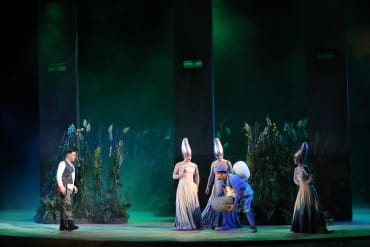
Hardy Činčurak made her debut at the Croatian National Theatre in Osijek in 2010 as Papagena in W. A. Mozart’s The Magic Flute. In 2015, she performed the role of Donna Anna in Mozart’s Don Giovanni at the Croatian National Theatre in Osijek. With the Orchestra of the Croatian National Theatre in Osijek, she has performed A. Vivaldi’s Gloria and G. Fauré’s Requiem, and has also appeared at the June Opera Night.
She is active as a concert singer in Croatia and abroad, performing at festivals including the Hvar Summer Festival, Osijek Cultural Summer, Cavtat Music Evenings and the Eltz Concert Series. As part of the Cres Cultural Evenings, under the artistic direction of Maestro Simon Dešpalj, she has performed a number of operatic roles, including Anna Bolena, Elettra in Idomeneo and Helmwige in Die Walküre, among others.
She has performed with the Zagreb Philharmonic and the Mostar Symphony Orchestra and collaborates with the Art Without Borders chamber ensemble in Dubrovnik. She has received numerous awards at international singing competitions, both as a soloist and as a mentor. In 2016, she received a commendation from the Academy Council for her outstanding contribution to artistic projects.
Mario Čopor
Mario Čopor studied piano at the Elly Bašić Music School in Zagreb under Professor Ljubomira Minja Kolak. He graduated from the University of Zagreb Academy of Music in 1995 and completed his master’s degree there in 1998 in the class of Professor Stjepan Radić. He continued his studies in Austria with Professor Ludwig Hoffmann as a solo pianist and with Professor Konrad Richter as a pianist specialising in vocal music, with a particular focus on opera and Lied.
While still at secondary school and later during his university studies, he received prestigious awards at national competitions. He has performed in Croatia and abroad—from Japan and throughout Europe to the United States and South Africa—as a soloist with musical ensembles and orchestras and as a member of chamber ensembles. He received the Rector’s Award for his performances in Japan.
Opera singers hold a particularly important place in his artistic career. As a répétiteur, he has collaborated and performed with many renowned opera singers, as well as with performers from musical theatre, operetta, popular music and jazz, with whom he has made several recordings. His work as a vocal coach and accompanist is distinguished by a high level of artistic quality and a thorough understanding of the particular characteristics and demands of vocal expression across a wide range of genres.
He is employed as an Artistic Adviser (répétiteur) in the Department of Voice at the University of Zagreb Academy of Music.