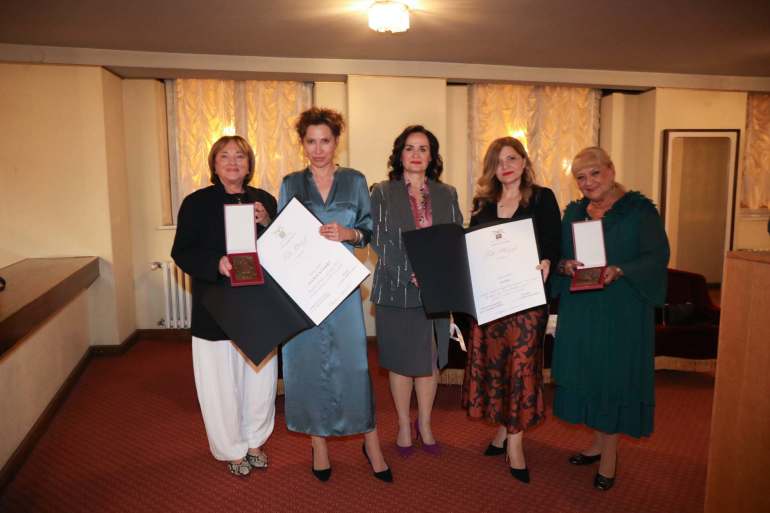
The Tito Strozzi Award for the 2025/2026 Season Jointly Awarded to the CNT Opera and Drama EnsemblesOther — 15. October 2026.
The Croatian National Theatre in Zagreb’s Tito Strozzi Award for the 2025/2026 season has been jointly awarded to the Opera and Drama ensembles for their outstanding artistic achievements in Giuseppe Verdi’s Aida and Friedrich Schiller’s Mary Stuart, two productions that defined the last theatre season.
Giuseppe Verdi’s Aida, directed by Mario Pontiggia and conducted by Pier Giorgio Morandi, premiered on 27 February 2026 at the Croatian National Theatre in Zagreb as a European co-production with Teatro Massimo in Palermo and the Csokonai National Theatre in Debrecen. The Drama ensemble of the Croatian National Theatre in Zagreb premiered Friedrich Schiller’s Mary Stuart, directed by Matija Ferlin, on 8 May 2026 at HNK2.
The jury consisted of Zdenka Weber, PhD, as Chair, and members Academician Hana Breko Kustura, Željka Turčinović, Tomislav Čadež and Svebor Sečak, PhD. The Tito Strozzi Award is presented for the best premiere productions in Drama, Opera and Ballet staged as part of the Croatian National Theatre in Zagreb’s repertoire during the previous season.
Giuseppe Verdi’s Aida
EXPLANATION
On 27 February 2026, the Croatian National Theatre in Zagreb presented a new production of Verdi’s Aida, one of the grandest and most complex works in the operatic repertoire, as part of a European co-production with Teatro Massimo in Palermo and the Csokonai National Theatre in Debrecen.
Aida is a grand opera in the great Italian tradition, in which Verdi skilfully supports the dramatic action with masterful orchestration while also creating magnificent choral scenes, introspective passages and a triumphal march. The superbly crafted dialogues lead convincingly towards the opera’s conclusion, marked by the subtle tenderness of its two central characters, Aida and Radamès. In short, it is a brilliant, lavish and monumental spectacle, perfectly suited to the occasion for which it was created.
The CNT Orchestra and Chorus were complemented by outstanding contributions from the Ballet ensemble, the Opera’s scholarship holders and members of the Opera and Ballet Studios.
This new production of Verdi’s Aida will certainly delight lovers of Italian bel canto and admirers of music theatre in all its visual forms. The soloists, Opera Chorus and Orchestra, and ballet dancers, under the direction of Mario Pontiggia, with set design by Antonella Conte, costumes by Ilaria Arlamme and lighting design by Andrea Ledda, and conducted by Pier Giorgio Morandi, delivered a superb performance lasting nearly four hours. The audience responded with prolonged applause and a level of enthusiasm rarely witnessed in recent years.
With this production of Aida, the Zagreb Opera has created a performance that can confidently stand alongside the greatest opera productions in the world, not only in terms of the quality of its performance but also through the completeness and coherence of the artistic contributions of all the performers and ensembles involved. Both as a whole and in its individual components, the production is truly an operatic masterpiece of the season. Particularly impressive are the mass scenes in Acts I and II, which blend seamlessly with the opera’s visual design and make the entire production a truly inspired artistic achievement.
The soloists deserve particular praise for both their acting and vocal performances: the outstanding portrayal of the title role by soprano Kristina Kolar and the particularly compelling interpretation of Amneris by Sofija Petrović. Stefano La Colla, Tomislav Muže and Stjepan Franetović also delivered excellent dramatic and vocal performances as Radamès. Ljubomir Puškarić and Badral Chuluunbaatar made a strong impression as Amonasro, while Luciano Batinić and Ivica Čikeš portrayed Ramfis, and Mate Akrap and Toni Nežić performed the role of the King. The role of the High Priestess was performed by Josipa Lončar and Hana Ilčić. Ivo Gamulin, Lovro Gujinović and Josip Švagelj appeared as the Messenger.
Last but not least, the dancers of the CNT Ballet and Ballet Studio made a major contribution to the scenes set in the lavish halls of the palace and the temple. Their performances elevated the splendour of the Egyptian court, already brought to life through the set and costume designs, to an even higher, truly spectacular level. With Aida, the Croatian National Theatre in Zagreb opened the 4th International Zagreb Opera Festival on 11 September 2026, presenting a production that further attests to the overall success of this staging of Verdi’s masterpiece.
In view of all the above, and considering the production of Verdi’s Aida at the Croatian National Theatre in Zagreb as a whole, we award the Tito Strozzi Award for the 2025/2026 season to this production.
Zdenka Weber, PhD
Friedrich Schiller’s Mary Stuart
EXPLANATION
The jury for the Tito Strozzi Award unanimously awarded the prize for the best Drama production of the Croatian National Theatre in Zagreb in the 2025/2026 season to Mary Stuart, directed by Matija Ferlin.
The early nineteenth-century classicist historical drama Mary Stuart may at first glance, in its original form, seem anachronistic and decorative, dominated by Baroque ornamentation. However, the creative and acting teams behind this production have completely dispelled that impression with a highly contemporary interpretation of the text.
The text is stripped of unnecessary poetic and linguistic virtuosity, both in its language and its action, while the performance focuses on dramatic situations and universal themes: the vehement and dangerous connection between power and violence; female gender identity in a patriarchal society, which defines a woman’s relationship with power; and the distinction between justice and law, which remains as relevant today as ever. Director Matija Ferlin and dramaturg Goran Ferčec have brought the text into the present without betraying Schiller’s original, highlighting those aspects that remain relevant today. Direction and choreography merge into an organic whole that explores the relationships between body and space, set design and music.
The production’s richness lies in the interplay of its visual, physical and auditory layers, brought to life through the dedicated performances of an outstanding acting ensemble led by Jadranka Đokić as Mary Stuart and Nina Violić as Elizabeth, Queen of England.
Željka Turčinović


