Ahead of ‘Maria Stuart’, a Theatre Breakfast Was Held at HNK2Drama — 05. May 2026.
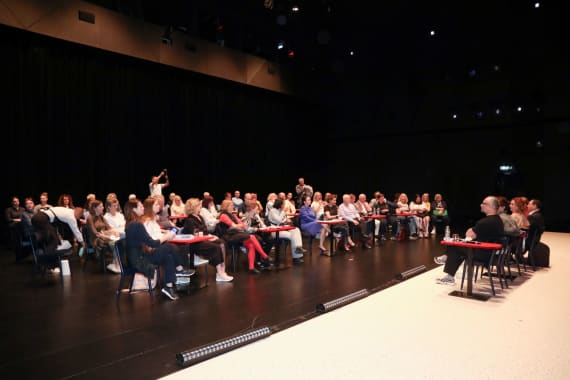
HNK2 stage, the venue today hosted its first Theatre Breakfast—a programme format designed to bring audiences and artists together, offering insight into the creative process behind the scenes, encouraging dialogue, the exchange of perspectives, and a deeper understanding of the performance.
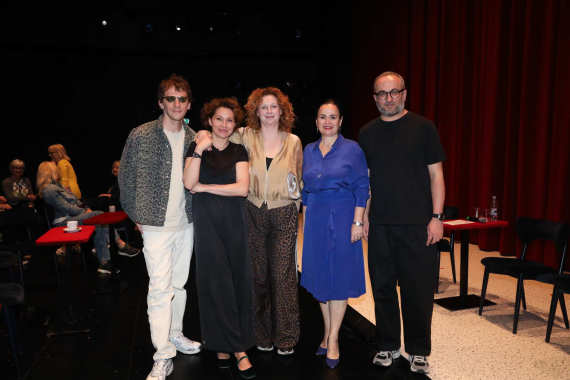
The Theatre Breakfast, organised in anticipation of the upcoming premiere of Friedrich Schiller’s Maria Stuart, directed and choreographed by Matija Ferlin, scheduled for this Friday, 8 May, attracted a large audience. Taking part in the discussion were Dr Marijan Bobinac, university professor and scholar of German literature, director and choreographer Matija Ferlin, dramaturg Goran Ferčec, and national principal actress Nina Violić, who performs the role of Elizabeth I. The discussion was moderated by Željka Turčinović
“It is the first time Matija and I have worked together, and I truly love his artistic world. Ferlin’s artistic language is visually exceptionally rich, and as a performer, I have always found it deeply compelling. I explored in depth, starting from the body, that powerful and often frightening fear of a woman who is free, passionate, and speaks directly. Mary is impulsive, while Elizabeth is a woman who carries an almost pathological fear of such openness, because in her, everything is suppressed and concealed. To play out this conflict with Jadranka Đokić has been incredibly inspiring, because for me Jadranka is truly a strong and stimulating artistic partner,” said Nina Violić.
Director and choreographer Matija Ferlin also reflected on the creative process with the ensemble: “The structure of the performance is highly precise. Everything has its place. Within that structure, the actors search for space for their own artistic interpretation. What matters to me is a sense of togetherness, a working environment that is open, supportive, and built on trust. And that is precisely what existed throughout this process—a positive spirit and a sense of stability.”
The participants also discussed the challenges of reinterpreting a dramatic classic, the question of the actor’s creative agency, and the ways in which a historical text can be read and staged within today’s social and political context. “In theatrical readings such as this, we need to move beyond the imperative of relevance, which merely confirms that in the past we recognise our own patterns of power and authority. Such an approach absolves the present of responsibility, because it sees only itself in history instead of truly confronting it,” said dramaturg Goran Ferčec, while professor Marijan Bobinac reflected on the enduring relevance of Schiller’s drama, whose themes continue to resonate strongly in public discourse.
Following its premiere on 8 May, the production will also be performed on 9, 14, 15, 16 and 23 May.