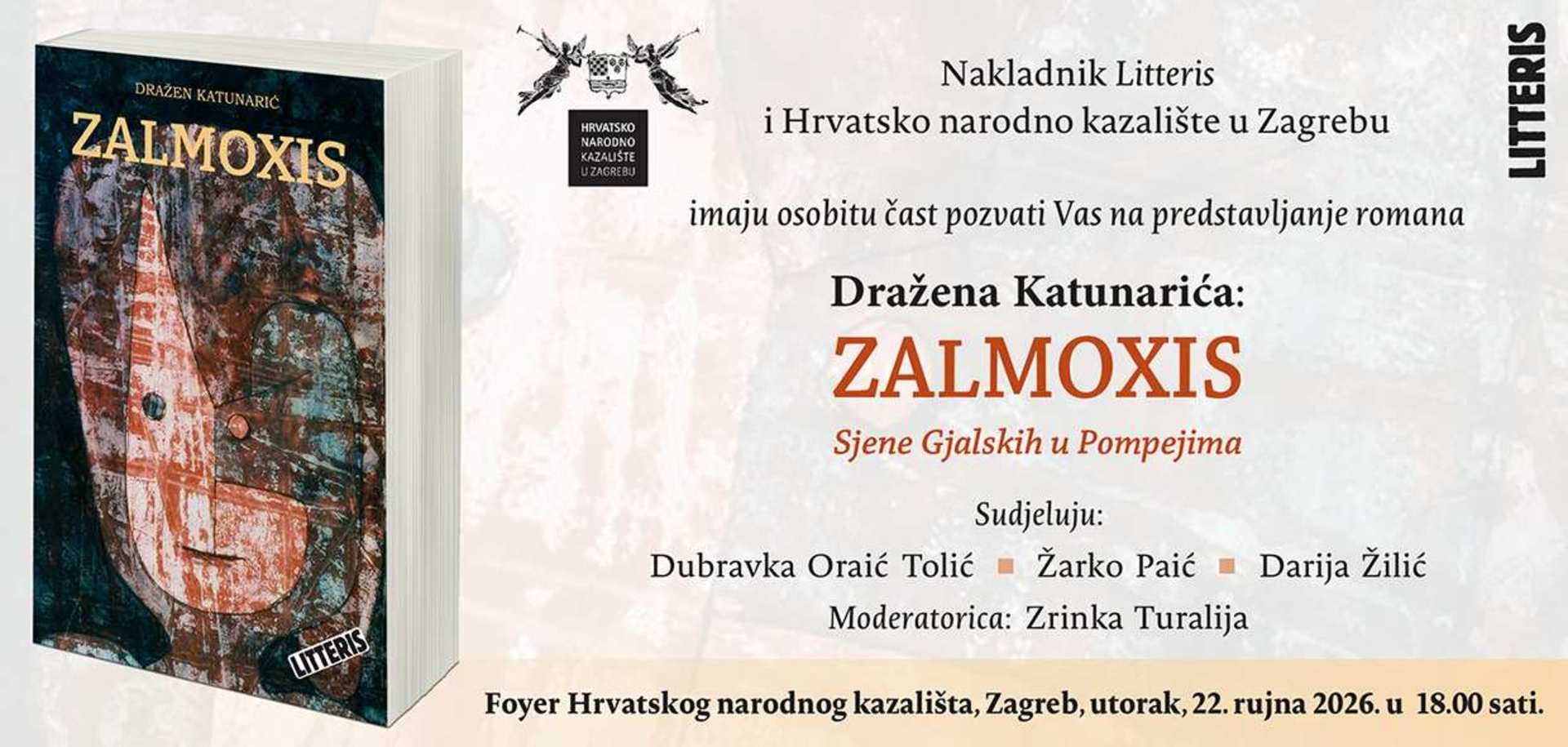
The novel Zalmoxis: The Shadows of the Gjalski Family in Pompeii by Dražen Katunarić will be presented in the foyer of the Croatian National Theatre in Zagreb on 22 September at 6 p.m. The book will be discussed by Dubravka Oraić Tolić, Žarko Paić and Darija Žilić. The discussion will be moderated by Zrinka Turalija, and the author, Dražen Katunarić, will also attend the event.
In the ancient Roman city of Pompeii, beneath Mount Vesuvius, begins a novel tracing five generations of the Gjalski family. From Naples, Geneva, Zagreb, Paris, London and Belgrade to the dark caves of Romania, and set against the apocalyptic backdrop of war, the story explores the legacy of one of Croatia’s best-known writers, Ksaver Šandor Gjalski, and the curse that follows his descendants like a persistent shadow.
In Pompeii, the novel’s protagonist Josip meets Marta, the last of the Gjalski family, a young archaeologist searching for a lost family relic – a mysterious painting of Zalmoxis, a deity worshipped by the Getae in ancient times. The search soon becomes a confrontation with a legacy concealing far more than lost and stolen treasures. Grounded in the contours of history, Katunarić’s novel delves into the fragile realm of family relationships and destinies, secrets, betrayals and tragedies.
As Tolstoy wrote, all happy families are alike; each unhappy family is unhappy in its own way. The Gjalski family is one of them, and its misfortune takes the form of a curse passed down from one generation to the next.
At the heart of the novel is also the question of fiction extending into life, as well as a Borgesian twist in which the destinies of Gjalski’s literary characters are mapped onto the tragic fates of his real-life descendants and family members. Borges himself, a resident of Geneva and a reader of Gjalski, appears in the novel, foreshadowing that what was once literature will become reality.
Written in the historical present tense at Ksaver Šandor Gjalski’s original writing desk, Zalmoxis: The Shadows of the Gjalski Family in Pompeii was conceived as a novel of destinies rather than a conventional family saga or biographical novel. Employing the cinematic technique of flashbacks and temporal leaps across earlier generations, it gradually approaches the family secret that forms the background and framework of the central story of Marta and Josip’s relationship. The figure from whom everything begins and who connects the different generations is Ksaver Šandor Gjalski, while the motif of the “third person”, legitimate and illegitimate children, and the sins of the fathers seemingly exacted upon the lives of their descendants recurs throughout the family’s history.
The novel thus asks whether a curse – an irrational force of destiny acting across several generations – can still exist today and, if so, whether it can be broken. One possible answer lies in restoring the lost sacredness of life. The search for the painting of Zalmoxis is therefore both literal and symbolic: the family’s troubles begin with the disappearance of the image of the ancient prophet, but also with the loss of the divine presence that lies dormant within each of us.