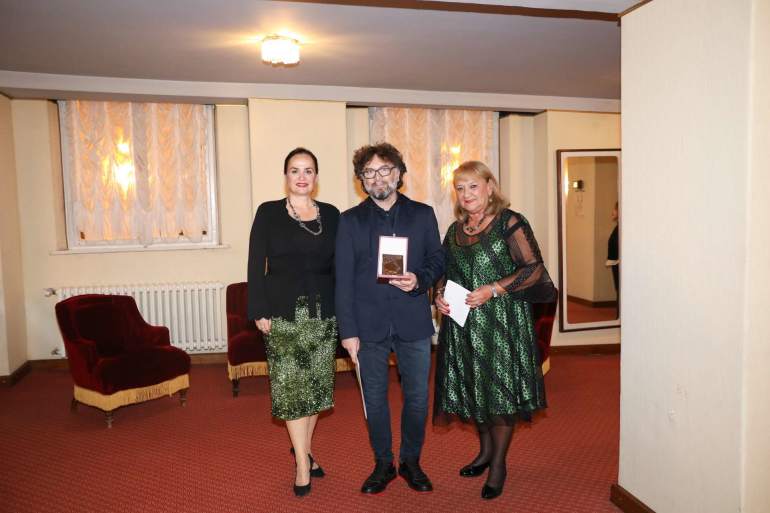
The Tito Strozzi Award 2024/2025 was awarded to ballet performances The Firebird and Petrushka From the theatre — 15. October 2025.
The Tito Strozzi Award for the 2024/2025 theatre season was awarded to the ballet performance The Firebird/Petrushka choreographed by Maša Kolar and Edward Clug to the music of Igor Stravinsky, conducted by Valentin Egel that premiered on November 15, 2024. The jury for the award, dedicated to the great Croatian actor and theatre artist Tito Strozzi, consists of the following experts: Dr. Zdenka Weber, president and Željka Turčinović, Tomislav Čadež, Dr. Hana Breko Kustura and Irena Pasarić members. This year, the award ceremony was held in a particularly festive atmosphere, precisely on the birthday of Tito Strozzi, which coincides with the 130th anniversary of the opening of the Croatian National Theatre in Zagreb. The award is granted to the best premiere performance in Drama, Opera and Ballet, realized in the repertoire of the Croatian National Theatre in Zagreb in the previous season.
Explanation of the Tito Strozzi Award 2024/2025
Irena Pasarić, member of the committee for the Tito Strozzi Award
Ballets The Firebird and Petrushka that premiered in 1910 and 1911 in Paris and were choreographed by Mikhail Fokine, launched composer Igor Stravinsky into the forefront of the European avant-garde. From their creation at the beginning of the 20th century to the present day, these short ballets have remained a great challenge for the world's greatest ballet stages, choreographers and dancers. The same challenge was accepted by choreographers Maša Kolar and Edward Clug, who, with a contemporary interpretation of Igor Stravinsky's score, enriched the Zagreb ballet repertoire with another excellent ballet performance that delighted the Zagreb audience.
Maša Kolar shaped her choreography with a meticulous stylistic dance narrative and stylized aesthetics, visually relying, in collaboration with set and costume designer Petra Pavičić, on the legendary poster by Boris Bućan, designed in 1982 for the Split premiere of the same ballet. With her contemporary ballet vocabulary and creative skill, she evoked the divine power of the mythical bird, as well as its destructive, devastating force. By successfully combining Igor Stravinsky's music and Boris Bućan's visual masterpiece, choreographer Maša Kolar created a dynamic and tense space of contemporary fairy-tale fantasy with her simple, sensitive and thoughtful approach to the classics.
Choreographer Edward Clug is a fan of Igor Stravinsky's music, and with his authentic choreography of Petrushka he has delved deeply into the layers of the human psyche, which he truly knows with his refined artistic sensibility. In an intimate dialogue with the music of the beloved composer, he transforms his legacy into a contemporary stage expression. Edward Clug has masterfully staged and choreographically shaped the timeless ballet story Petrushka and through the world of puppets he has conjured up the complexity and weakness of human characters. His Petrushka is adorned with a wide range of well-known human traits, all the way to the grotesque, the fantastic and, ultimately, the tragic disappearance, hinting that the boundary between real life and imagination is quite fragile, and people often unknowingly agree to be turned into puppets. The opulence of Stravinsky's music, fully evoked by the choreography, is enhanced by the scenic simplicity of Marko Japelj's set design and the visual splendor of Leo Kulaš's costumes.
Although completely different in style and atmosphere, both ballets, through thoughtful elaboration in every detail, achieved a dramatic quality, filled with deep poetic emotion. The performers responded to all the tasks set before them with suggestive empathy with the characters, with great technical precision in interpretation, regardless of the role they were assigned. Stravinsky's musical score, with its rich narrative, offers numerous possibilities for musical interpretation, which the Orchestra of the Croatian National Theatre in Zagreb, enriched with additional instruments, under the direction of Valentin Egel / Vjekoslav Babić, fully exploited, reaffirming its brilliant reputation.


